
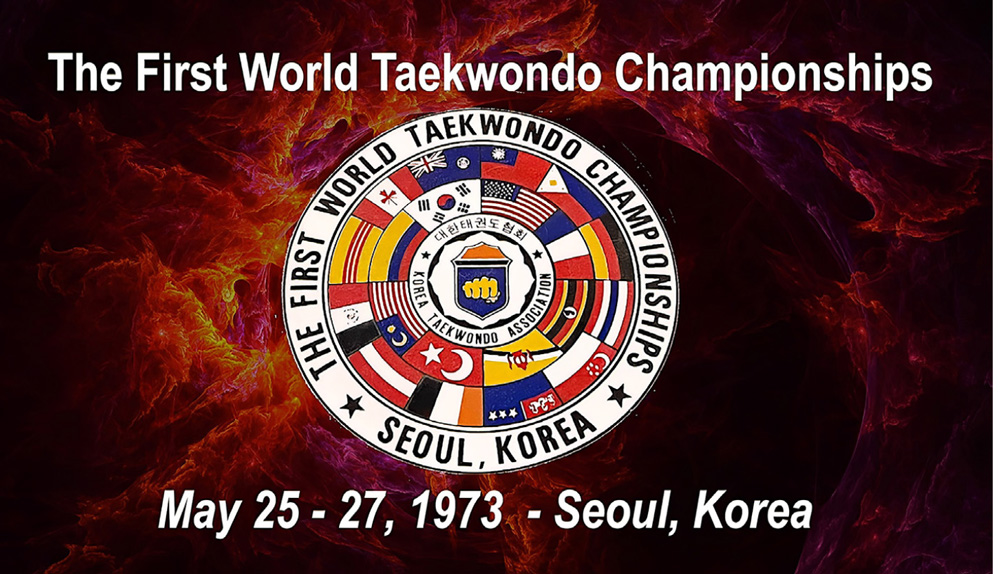
From Denton, Texas to Seoul, Korea: Competing in the First World Taekwondo Championships
In late 1972, I heard about a tournament in Dallas that could qualify a fighter for something that sounded almost unbelievable at the time:
A chance to travel to Seoul, Korea, as a member of a United States team competing in the first World Taekwondo Championships.
All expenses paid. Naturally, I wanted to go.
I entered the qualifying tournament in Richardson, Texas, along with a large group of other Black Belts hoping to earn a place on the team.
I won one or two matches before drawing Roger Carpenter of Wichita, Kansas.
I had beaten Roger before, but Roger was the kind of fighter who could hurt you even when you won.
This time he did both. He hurt me—and he beat me.
I drove home to Denton convinced my chance to go to Korea was over.
Then the Phone Call Came
Ahn Ye Mo was the tournament director and Mission Leader for the U.S. team.
Sometime after the qualifier, I was contacted and offered a position on the team.
Roy Kurban, who had qualified for a spot, had given up his place.
That spot was offered to me.
I was going to Korea.
In May 1973, the competitors and coaches assembled in Los Angeles for the trip to Seoul. I paid my own airfare from Texas to Los Angeles, with the understanding that the rest of the trip would be covered from there.
At the airport, I knew Roger Carpenter and Howard Jackson. But I was also meeting fighters such as Albert Cheeks, Joe Hayes and Mike Warren—some of the standout competitors from the East Coast.
We were about to become teammates.
Or so I thought.
The Plane Left Without Me
There were two American teams going to Korea, with five competitors and an alternate on each.
As everyone prepared to board the 747, tickets were being handed out.
Except two of us didn’t get one.
Howard Jackson and me.
We were told to wait while everyone else boarded.
Then the airplane door closed.
The plane pulled away from the terminal.
It taxied down the runway.
And Howard and I stood there and watched our team take off for Korea without us.
I couldn’t believe it.
I had paid my way from Dallas to Los Angeles. I had even contributed additional money when the group discovered there wasn’t enough money for everyone’s tickets.
And now I wasn’t going anywhere.
Then Something Remarkable Happened
While Howard and I were discussing what had happened, an announcement came over the airport intercom asking me to report to the ticket counter.
The flight had developed a hydraulic problem.
The airplane was coming back.
While aboard, the Koreans had managed to put together enough money to purchase one more ticket.
That ticket was for me.
Unfortunately, there still wasn’t a ticket for Howard, so he did not make the trip.
When the airplane returned, the airline put me on a baggage cart and drove me out onto the runway.
I climbed the portable stairs and boarded.
Everyone cheered.
Nobody on that airplane was happier than I was.
I had already beaten some pretty amazing odds—and the competition hadn’t even started.
Meeting My U.S. Teammates
On the flight, I finally had time to get to know some of the men I’d be competing beside.
I had read magazine stories about “Jumping” Joe Hayes and his aerial kicking attacks.
I met Mike Warren for the first time. Mike was one of the most talented karate competitors I ever encountered. His speed and body control were amazing, and his kicking ability influenced me greatly.
Albert Cheeks was about my size and had already made a name for himself on the East Coast.
My East U.S. “A” Team consisted of Albert Cheeks, Joe Hayes, Mike Warren, Archie Cole and me.
The other American team included competitors such as Roger Carpenter, Fred Absher, Mike Ajay, Chris Doubek and Bobby Martin.
We were going halfway around the world to find out how we measured up.
Arriving in Seoul
One of the first things I noticed when we arrived in Seoul was the military presence.
It made an impression on a young guy from Texas.
Our Korean coaches also took us through the streets of Seoul to train. We would run through the streets in uniform and occasionally stop at intersections to work out where people could see the American team.
The experience was unlike anything I had encountered at home.
Soldiers at the airport were positioned looking north with large mounted weapons, prepared in case something happened with North Korea.
Walking Into the Kukkiwon
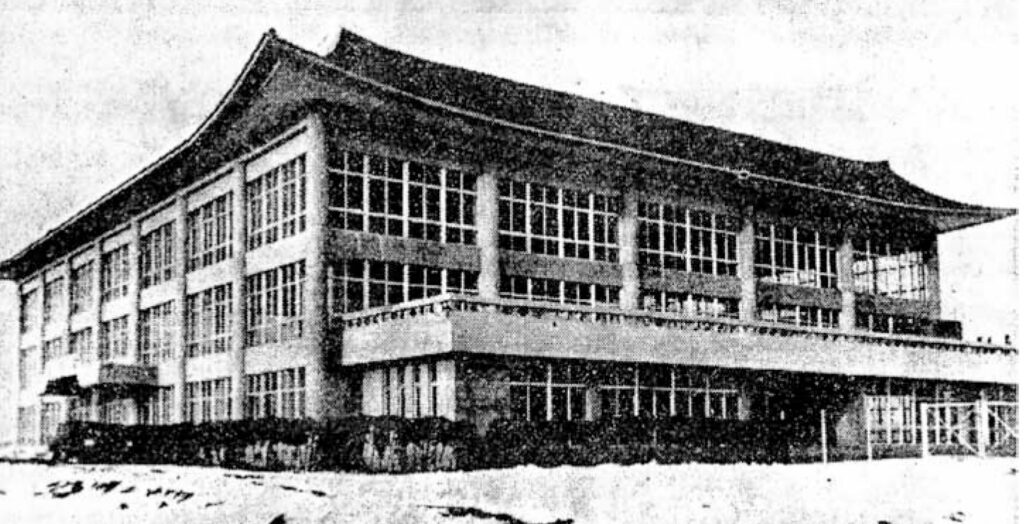
We were taken to the Kukkiwon, the headquarters of Taekwondo.
Then came the competition.
In 1973, it sat on a hill without the surrounding development that would come later.
By the final day, people seemed to be everywhere outside, hoping to catch a glimpse of the competitors and dignitaries arriving.
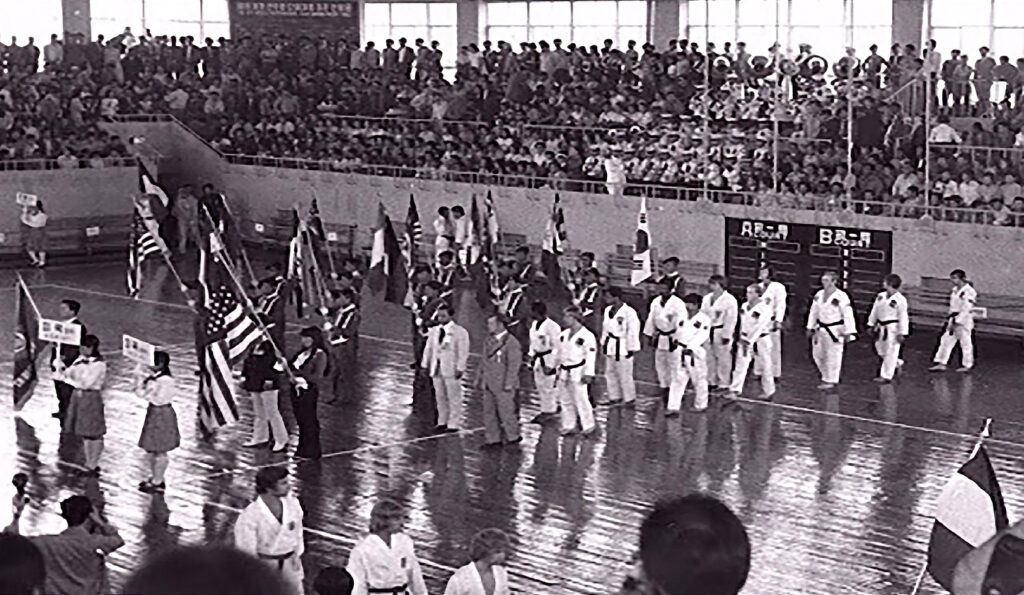
Inside were approximately 3,000 spectators, along with top Korean political and military officials.
We rehearsed the ceremony and marched in carrying the American flag.
To me, it felt like what I imagined competing in the Olympics might feel like.
Rules We Weren’t Used To
The competition was very different from the American tournament karate I knew.
Matches consisted of three two-minute rounds, with 30 seconds of rest between rounds.
A fist attack earned one point.
A kick to the body earned one point.
A kick to the head earned two.
Competitors wore red or blue body protectors, but there were no hand or foot coverings and no headgear.
One of the biggest differences was that we weren’t told the running score. The officials recorded the points, and you didn’t necessarily know whether you were ahead or behind as you entered the next round.
That changed the way you had to think about a fight.
Facing Korea
Eventually our East U.S. team faced the Korean team.
My opponent was Jung Do Choi. He attacked relentlessly with powerful kicks.
Because I’m left-handed, we fought from opposite stances. I would slide back from his attacks, block his kicks and counter with punches to the body.
Back in American competition, I could often hit someone hard enough in the body to knock the air out of him or force him to take a knee.
But these competitors were wearing body armor.
My punches weren’t slowing him down the way I expected.
We fought all three rounds.
When it was over, the referee raised the Korean fighter’s hand.
I had lost.
I thought I had outscored him.
The Korean team advanced, and we went into the losers bracket.
Fighting Our Way Back
Losing didn’t mean we were finished.
The tournament format gave us a path through the losers bracket and back into the championship.
We defeated Germany.
Then came a team match against the Republic of China that I will never forget.
One after another, my teammates became involved in situations where punches to the head resulted in double disqualifications.
By the time my match arrived, the entire outcome rested on me.
My opponent was Liou Jyh Horng, the largest fighter on their team.
I hit him with several good techniques, including one of my favorite counterattacks—a defensive turning back kick that dropped him to the floor.
Going into the final round, I believed I was well ahead.
Then Horng jumped up and hit me as hard as he could on the chin.
I landed on my backside and slid across the ring.
Sitting there rubbing my chin, I looked at him and thought:
Yeah, we can do that!
My coaches immediately started yelling at me not to punch him in the face.
Then I understood.
If I retaliated and knocked him down with a head punch, I could be disqualified too—and our team could lose its chance to advance.
So I got back up.
And I didn’t throw another punch for the remainder of the match.
When time expired, the referee raised my hand.
We were going back to the finals to face Korea again.
May 27, 1973 — The Championship
The final was held May 27.
The Korean president, Park Chung Hee, Taekwondo Association president Un Young Kim, military leaders, political dignitaries, television crews and the media were there.
And once again:
Korea versus the United States.
Mike Warren gave an outstanding performance and won his match.
Then it came around to me again.
I faced Jung Do Choi for the second time.
Our match was much like the first, although he was somewhat more cautious.
After three rounds, this time the officials scored our match a tie.
Korea won the championship.
Our United States team finished second.
Jim’s book describes it as second place among 26 competing countries; elsewhere in the book’s photo caption he says 27 countries, so I’m deliberately not changing that discrepancy for him. For the blog, I’d simply say “the United States won the silver medal.”
A Silver Medal—and a Piece of Taekwondo History
At the time, I was simply a competitor trying to win.
Only later did I fully appreciate what we had been part of.
This was the first World Taekwondo Championships.
I had almost missed the trip.
I had watched the airplane leave without me.
Then the plane came back.
I made it to Korea.
I competed inside the Kukkiwon.
I fought some of the best Taekwondo competitors in the world.
And our American team came home with the silver medal.
Years later, on April 6, 2007, I was reunited with members of that team when I was inducted into the Taekwondo Hall of Fame.
I was invited to return to Seoul to compete on the U.S. team again in 1975.
I declined.
But nothing could ever replace that first trip.
In 1973, we weren’t just competing in another tournament. We were there at the beginning of something that would become part of international Taekwondo history.
And somehow, despite everything that happened before that airplane ever left Los Angeles, I was fortunate enough to be there.
— Jim Butin
SEO information
SEO Keyphrase: First World Taekwondo Championships 1973
SEO Title: 1973 First World Taekwondo Championships | Jim Butin
Meta Description: Jim Butin recalls representing the United States at the first World Taekwondo Championships in Seoul, Korea, in 1973 and winning a silver medal.
Barbara, this is a cornerstone article, just like the Dream Team. The historical record I checked independently also lists “James Butin” on the 1973 U.S. team roster at the first World Taekwondo Championships in Seoul.
And there are several fantastic photographs in this section of Karate Stories. When we actually build this page, I would use more than one. This story deserves a feature photo plus two or three historical images throughout the article.
So now we have a wonderful sequence:
Week 9 — 1974 U.S. Karate Dream Team
Week 10 — 1973 First World Taekwondo Championships
These aren’t ordinary blog posts anymore. We’re putting Jim’s firsthand martial-arts history online where Google can actually find it.